
DMS integration is a solved problem for some teams and a recurring headache for others. The difference isn't usually resources. It's architecture, early decisions, and understanding what you're actually dealing with before you're three months into a build.
This article covers what DMS integration is, how it works technically, and why most teams underestimate the complexity until they're already neck-deep in it.
What Is DMS Integration?
The Definitive Guide for Automotive Vendors and OEMs
Your product team spent ten weeks building a DMS integration for CDK Global. You shipped it. Then your next OEM client told you their dealer network runs Reynolds & Reynolds, and a third of those stores are on Tekion. You're not starting from scratch, exactly. But you're close enough that it stings.
That's the situation most vendor and OEM teams are in. DMS integration is a solved problem for some teams and a recurring headache for others. The difference isn't usually resources. It's architecture, early decisions, and understanding what you're actually dealing with before you're three months into a build.
This article covers what DMS integration is, how it works technically, and why most teams underestimate the complexity until they're already neck-deep in it.
DMS integration is how external software connects to a dealer's management system to access operational data. It requires an API connection, dealer consent, and data normalization. There are three methods: polling, push, and a unified API layer. The main challenges are DMS fragmentation (48+ types), inconsistent data formats, and compliance requirements. At scale, a single-connection platform beats building custom integrations per DMS every time.
What Is a Dealer Management System (DMS)?
A dealer management system (DMS) is the operational backbone of a car dealership. It runs inventory, sales, F&I, service, parts, and accounting, covering everything that keeps a store open and profitable. If something happens at a dealership, the DMS knows about it.
The major DMS vendors in the US include CDK Global, Reynolds & Reynolds, Dealertrack (Cox Automotive), Tekion, and Dominion VUE, among others. Between them, they cover the majority of franchised rooftops, but not a majority of the same rooftops. Dealer networks are fragmented across providers, and that fragmentation is the root cause of most integration complexity.
Inside a DMS, you'll find:
- Customer records and contact information
- Vehicle sales and transaction history
- Service and repair records (ROs)
- Parts inventory and pricing
- F&I deal structures and documentation
- Employee and dealership operational data
For vendors and OEMs, this data represents the ground truth of what's happening at the dealership level. CRM sync, marketing personalization, OEM program compliance, inventory management, warranty tracking: all of it depends on getting accurate, timely data out of the DMS. Which brings us to the actual problem.
What Is DMS Integration and Why Does It Exist?
DMS integration is the technical process by which external software systems, including vendors, OEMs, marketing platforms, and CRM tools, access, extract, and receive data from a dealership's DMS.
DMS systems were built to run internal dealership operations, not to serve data to outside parties. Data doesn't leave a DMS automatically. Nothing is broadcasting outward by default. To get data out, you need an integration layer, whether that's an API connection, a scheduled data feed, or a middleware layer, that reads from the DMS and delivers it to wherever your system needs it.
Technically, that means establishing a connection to the DMS provider's API or data extraction layer, authenticating, pulling or receiving the data, transforming it into a usable format, and delivering it to the destination system on a schedule or in real time. That's the core loop. The complexity lives in the details.
One more thing that stops many vendor teams short: the dealer has to authorize each integration. The data inside a DMS belongs to the dealership. It's not freely available to any vendor who wants it. Every connection requires explicit consent from the dealer principal or their designated administrator. Without that, there's no integration to build.
DealerVault is built around this exact model: one connection point that handles DMS access, dealer consent, and data delivery to authorized vendors, so neither the dealer nor the vendor has to manage that complexity themselves.
The 3 Core Methods of DMS Integration
How you get data out of a DMS depends on what the DMS vendor supports, what your system needs, and how fresh that data has to be. There are three primary integration methods in use today.
1. Polling (Pull-Based)
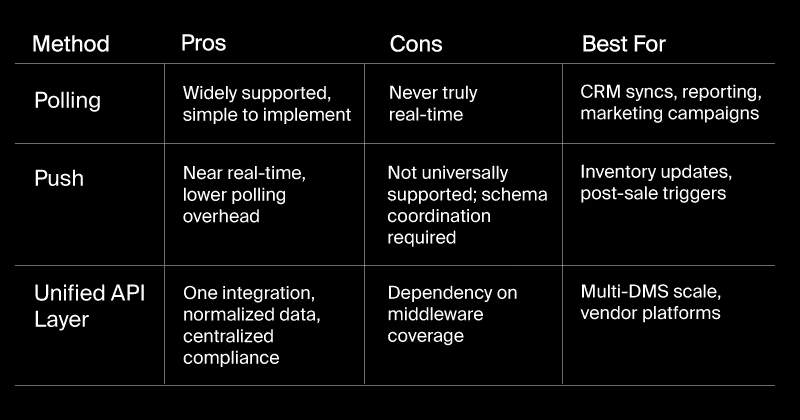
The most common method. Your integration layer sends a request to the DMS on a defined schedule, every 15 minutes, every hour, nightly, and pulls back whatever has changed since the last pull.
Polling is straightforward to implement and broadly supported across DMS vendors. The tradeoff is freshness: you're always working with a snapshot from the last cycle, not live data. For use cases like end-of-day reporting, CRM syncs, and marketing campaign segmentation, that's usually acceptable.
2. Push (Event-Based / Webhook)
In a push model, the DMS sends data to your system when something changes: a deal is finalized, a vehicle is sold, a service appointment is closed. Your system receives it in near real-time without having to ask.
Push is faster and puts less load on the polling cycle. The limitation is that not all DMS vendors support event-based push reliably, and when they do, both sides need to agree on schema and stay in sync as either platform evolves. Use cases that benefit most from push: real-time inventory feeds, immediate post-sale customer data sync, and time-sensitive OEM program triggers.
3. Unified API Layer (One Integration, Multiple DMS Types)
A middleware layer sits between your system and all the DMS platforms you need to reach. Your team integrates once, to the middleware, and the middleware handles all individual DMS connections, authentication patterns, and data formats.
Some teams build this internally. Others use purpose-built platforms designed specifically for automotive DMS connectivity. Either way, the architectural pattern is the same: a single normalized API contract your system talks to, with translation handled downstream. The upside is normalized data across all DMS types and compliance logic centralized in one place. The dependency is on the middleware provider's DMS coverage depth. See how DealerVault for Vendors handles this at scale.
Why DMS Integration Is Harder Than It Looks
The integration methods above are logical enough. The problem is execution at scale across a fragmented ecosystem.
48+ DMS Types, Each With Its Own Rules
There are over 48 distinct DMS systems actively in use at franchised dealerships in the US. Each one has different API schemas, authentication methods, field naming conventions, and update cadences.
A field called customer_email in one DMS is CustomerEmailAddress in another and doesn't exist at all in a third. A vendor who builds for one DMS has to effectively start over for the next, and again for the one after that. A new DMS integration typically takes 4 to 12 weeks of engineering time, and that's before you factor in ongoing maintenance every time a DMS vendor pushes a platform update.
Data Normalization: The Hidden Workload
Getting the data out is step one. Making it usable is step two, and it's often just as expensive.
Raw DMS data is inconsistent. Customer names are in all-caps in one system and mixed case in another. Phone numbers are formatted differently. VINs may be incomplete or formatted with spaces. Addresses aren't standardized. Before your system can use any of it, someone has to clean, validate, and normalize it, mapping fields to a consistent schema that your downstream applications can actually consume.
Teams that haven't done this before often scope the integration, forget to scope the normalization, and then discover the normalization is half the project.
Consent and Compliance Layer
Every DMS integration requires explicit dealer authorization. Under the FTC Safeguards Rule, vendors must be able to demonstrate that dealers opted in to share their data, and that means audit logs, documented consent workflows, and ongoing permission management as personnel turns over and franchise agreements change.
This is often where integrations stall. Not the technology. The paperwork, the process, and the liability question of who owns the data relationship. If your compliance layer isn't built before your integration goes live, you're exposed, and increasingly, DMS vendors and dealers know it.
What DMS Integration Looks Like at Scale
A vendor with 5 DMS integrations serving 200 dealers faces a different problem than a vendor with access to 48+ DMS types serving 5,000 dealers. The difference isn't just volume. It's the drag on everything else.
At low volume, maintaining custom adapters per DMS is manageable. Your integration team owns those connections, knows the quirks, and can handle updates. At scale, that maintenance load becomes the primary drag on product velocity. Teams spending 30% of engineering capacity on DMS adapter maintenance aren't building features. They're keeping the lights on.
The "integrate once, scale everywhere" pattern, whether built internally or handled by a middleware platform, exists because the math eventually forces the question. At what point does rebuilding adapters cost more than centralizing connectivity? For most vendor teams, that inflection point comes earlier than expected.
DealerVault solves this directly: instead of maintaining 48 separate DMS adapters, vendors connect once and get access to all covered DMS types with normalized data, real-time feeds, and dealer consent managed in one place. One connection. Consistent data. Full control over which streams are active.
Data freshness also matters more at scale. When a dealer updates a customer record in their DMS and your platform reflects it 24 hours later, campaigns go out on stale data. Service reminders miss the window. OEM program reporting is off. Real-time or near-real-time data pipelines aren't a luxury at scale. They're operational requirements.
Explore Authenticom's full product suite to see how this model is built in practice.
Frequently Asked Questions
What is DMS integration?
DMS integration is the process by which external software systems, such as CRM platforms, OEM programs, and marketing tools, access and receive data from a dealership's Dealer Management System (DMS). It requires an API connection, dealer authorization, and data normalization to be useful.
How many DMS types are there?
There are over 48 distinct DMS systems actively used by franchised dealerships in the United States, including platforms from CDK Global, Reynolds & Reynolds, Dealertrack (Cox Automotive), Tekion, Dominion VUE, and others. Each has its own API, data schema, and integration requirements.
What data can be accessed through DMS integration?
With proper dealer authorization, DMS integrations can access customer records, vehicle sales history, service and repair records, parts inventory, F&I transaction data, and employee information. What data is available depends on the DMS vendor and the scope of the dealer's consent.
How long does it take to build a DMS integration?
A single custom DMS integration typically takes 4 to 12 weeks of engineering time, depending on the DMS vendor's API documentation quality and the complexity of data normalization required. Maintaining that integration adds ongoing overhead as the DMS vendor updates their platform.
What is the difference between polling and push-based DMS integration?
Polling integration requests data from the DMS on a schedule (hourly, daily). Push integration sends data to the external system as soon as an event occurs in the DMS. Polling is more common and widely supported; push is faster but requires both systems to support event-based triggers.
Understanding DMS integration is the first step. The harder question, for most vendor and OEM teams, is how to scale it. Building and maintaining individual integrations per DMS type is a viable strategy at low volume. At scale, it becomes the thing slowing everything else down.
Connecting to 48+ DMS types doesn't have to mean building 48 integrations.
DealerVault connects to 100+ DMS types through a single integration point, with normalized data, dealer consent built in, and real-time feeds out of the box. Used by 12,500+ dealerships and processing millions of records daily.
See how DealerVault works | Talk to an integration specialist
This article covers what DMS integration is, how it works technically, and why most teams underestimate the complexity until they're already neck-deep in it.
DMS integration is how external software connects to a dealer's management system to access operational data. It requires an API connection, dealer consent, and data normalization. There are three methods: polling, push, and a unified API layer. The main challenges are DMS fragmentation (48+ types), inconsistent data formats, and compliance requirements. At scale, a single-connection platform beats building custom integrations per DMS every time.
DealerVault connects to 100+ DMS types through a single integration point, with normalized data, dealer consent built in, and real-time feeds out of the box. Used by 12,500+ dealerships and processing millions of records daily.