

DATA HYGIENE FOR AUTOMOTIVE
At the 2026 Women in Automotive conference, Michelle Phelps VP of Customer Success at Authenticom Group asked a room full of dealership leaders a question that should have an easy answer:
Where is your golden record of truth?

Data doesn’t fail because of one bad record. It fails because of hundreds of small, unaddressed ones.


What Is a Golden Record?
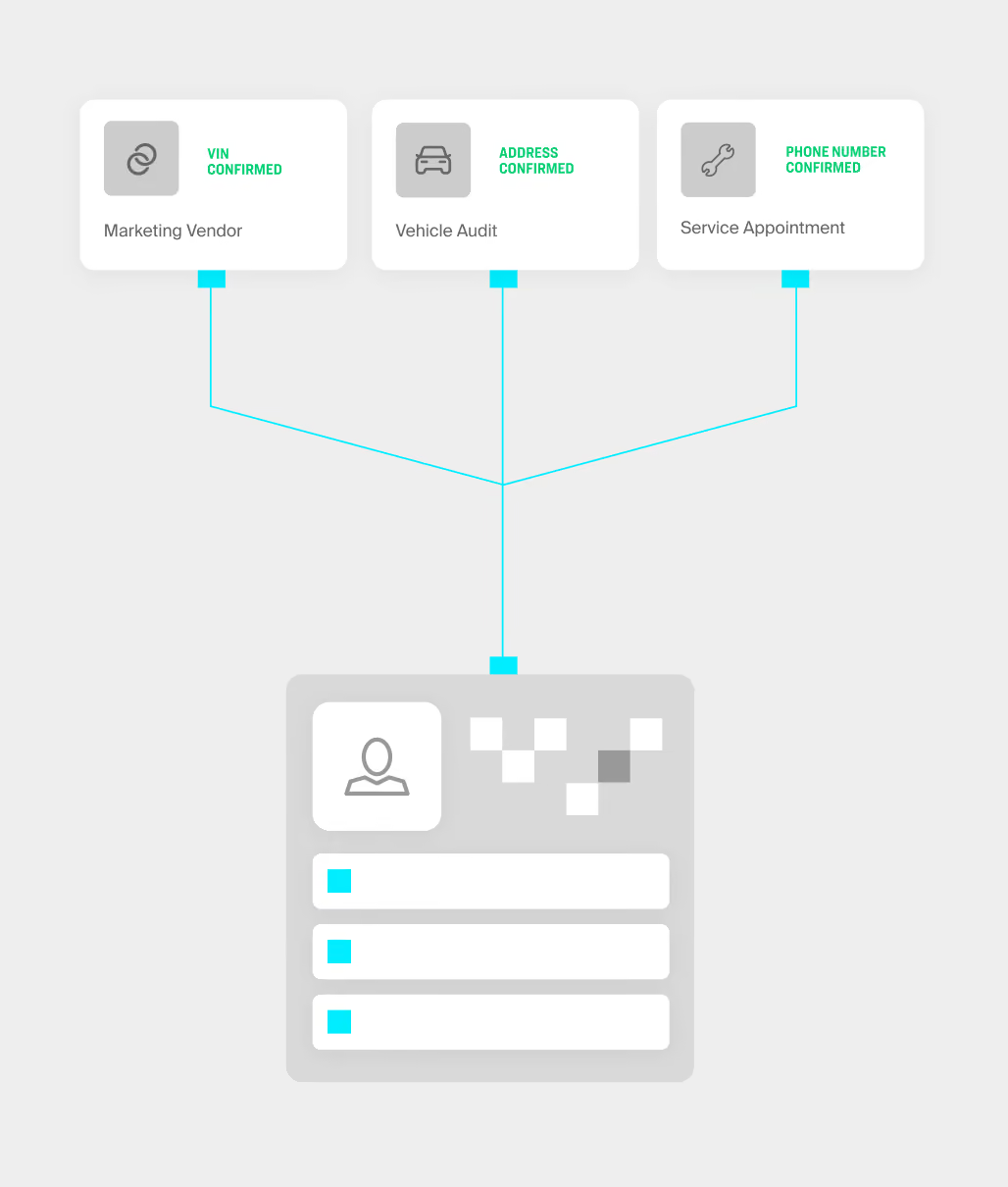
A golden record is the single, most accurate and complete version of a customer’s information.
It brings together data from across your systems to create one trusted customer record without duplicate profiles, conflicting details, missing information, or outdated fields.

It’s Not a Data Problem.
It’s a Relationship Problem.

Relationships rarely fall apart because of one catastrophic event. They erode through the small, often overlooked moments that go unaddressed. Moments like missed expectations, inconsistent communication, assumptions, and a lack of follow-through. All moments when customers can either feel like trust is forming or its being quickly eroded like a swift avalanche.
The truth is, data behaves the exact same way. One duplicate customer doesn’t seem disastrous. Neither does missing an email address here or there, an outdated phone number, or a field entered differently by two employees. These are all small things, right? Not really. Small problems accumulate. Sort of like death by a thousand paper cuts.
Eventually, one customer becomes three duplicate records. Your DMS and CRM disagree constantly. Reports tell wildly different stories. Follow-ups go nowhere. And the data your business depends on becomes the data nobody trusts. You suddenly feel like you can’t trust the very core of your business. That is how a few forgivable records become an expensive operational problem
The Five Stages of Data Grief
Most organizations don’t discover their data problem all at once.
They move through it in stages.
Denial
“Our data is fine.”
Small inconsistencies are dismissed until they become impossible to ignore.
Anger
“Whose fault is this?”
Systems, vendors, and employees get blamed for what is usually an ownership and process problem.
Bargaining
“One big cleanup will fix it.”
The database gets scrubbed, but without ongoing maintenance, the duplicates, missing fields, & outdated records return.
Depression
“Nobody trusts the data anymore.”
Reports conflict, dashboards get questioned, and decisions return to gut instinct.
Acceptance
“Someone needs to own this.”
The organization stops searching for someone to blame and starts building standards, accountability, and maintenance.
3–5% of Your Gross Revenue May Already Be Walking Out the Door
Bad data rarely announces its cost. It’s more like a silent, unwanted guest that sends revenue running for the door. The high cost of bad data is often found in unreachable customers, duplicate records, inventory that won’t budge, parts records that don’t add up, misdirected marketing spend, inconsistent reporting, F&I numbers that can’t be explained, and opportunities for upsells that slip through the cracks.
When it comes to major business decisions, leaving them up to chance isn’t a strategy. The lack of a golden record of truth isn’t just a dealership inconvenience. It can cost a salesperson’s salary. A significant portion of your marketing budget. A tightening budget that can’t bend for better inventory, repairs, or employee training. It’s the revenue your dealership worked to create but never had the data infrastructure to capture. And it may already be gone. Do you know how much of your customer data can actually be trusted?
of general managers say they rely on intuition over data when making major decisions.
Meanwhile, poor data quality can cost the average dealership an estimated 3–5% of gross revenue. Yet what isn’t recorded is how much of that “intuition” is actually backed by bad data?

Your AI Is Only as Good as the Data You Feed It
Dealerships are heavily investing in artificial intelligence (AI) across the customer journey. Acquiring lead handling and marketing forecasting tools, lead handling agents, service schedulers, and more.
The list is endless and AI will soon be embedded into every part of the buyer journey.
The problem? AI doesn’t fix the foundation beneath it. Whatever was already existing, only gets multiplied. Meaning AI doesn’t fix bad data, it spreads it. The last thing you want in your dealership operation is bad data running through every single touchpoint… making it virtually impossible to find your golden record of truth. Dirty data used to be a slow problem that employees could outwork, fixing manually when they had time. Not anymore. With AI, that slow problem becomes a fast moving tidal wave of inaccuracies.
But, there’s hope. If AI is given clean, connected customer data, it can surface opportunities, improve decisions, and make teams more effective. Because it has a solid, truthful record to stand on. Before jumping in and asking what AI can do for your dealership, ask if it has a golden record of truth to work with.
Data hygiene does not begin with perfection.
It begins with an honest look at where you are today.
The path forward is simple:
Find it. Fix it. Prevent it.
Go from good, to better, to best.

Start Where You Are: Good, Better, Best
Good:
Find the Problem
Start by understanding the actual condition of your database. Run an audit. Identify duplicate customers, missing information, outdated details, and records that can no longer be reached. Then standardize how information is entered so your team stops recreating the same problems.
RecordRecharge helps you establish that starting point by auditing, deduplicating, and assessing the reachability of your customer data.
Better:
Fix the Process
Once you know what is wrong, give someone responsibility for making it better. Assign a clear data owner. Establish consistent standards. Then rebuild one workflow at a time using cleaner, more dependable information. Whether that’s service-to-sales, equity mining, or dead-lead reactivation.
DealerVault helps dealerships consolidate and control the connections through which their data moves.
Best:
Prevent It From Happening Again
A database that stays clean is transformational.
Continuous monitoring helps catch duplicates, validation issues, unreachable records, and inconsistencies while they are still small. Data quality becomes part of the management conversation, with the same visibility and accountability as gross, CSI, and other numbers that shape dealership performance.
Data Experience Management brings monitoring, governance, visibility, insight, and action together so data quality can be managed continuously instead of revisited after the damage is done.
What a Golden Record Actually Looks Like
A golden record is the most complete, accurate, and dependable version of a customer’s information. It means the customer in your DMS is recognizable as the same customer in your CRM, service scheduler, marketing platform, F&I system, and every other place their information appears.
In plain language: The same customer looks like the same customer everywhere. That record becomes the trusted foundation for reporting, forecasting, marketing, customer communication, and AI. Because clean data isn’t the finish line. It is the foundation that makes everything else work.

Find YourGolden Record
Your dealership already has the data.
The question is whether it is accurate, connected, and dependable enough to guide what happens next.
Find the records you can trust.
Fix the ones you can’t. Build the processes that keep them healthy.